
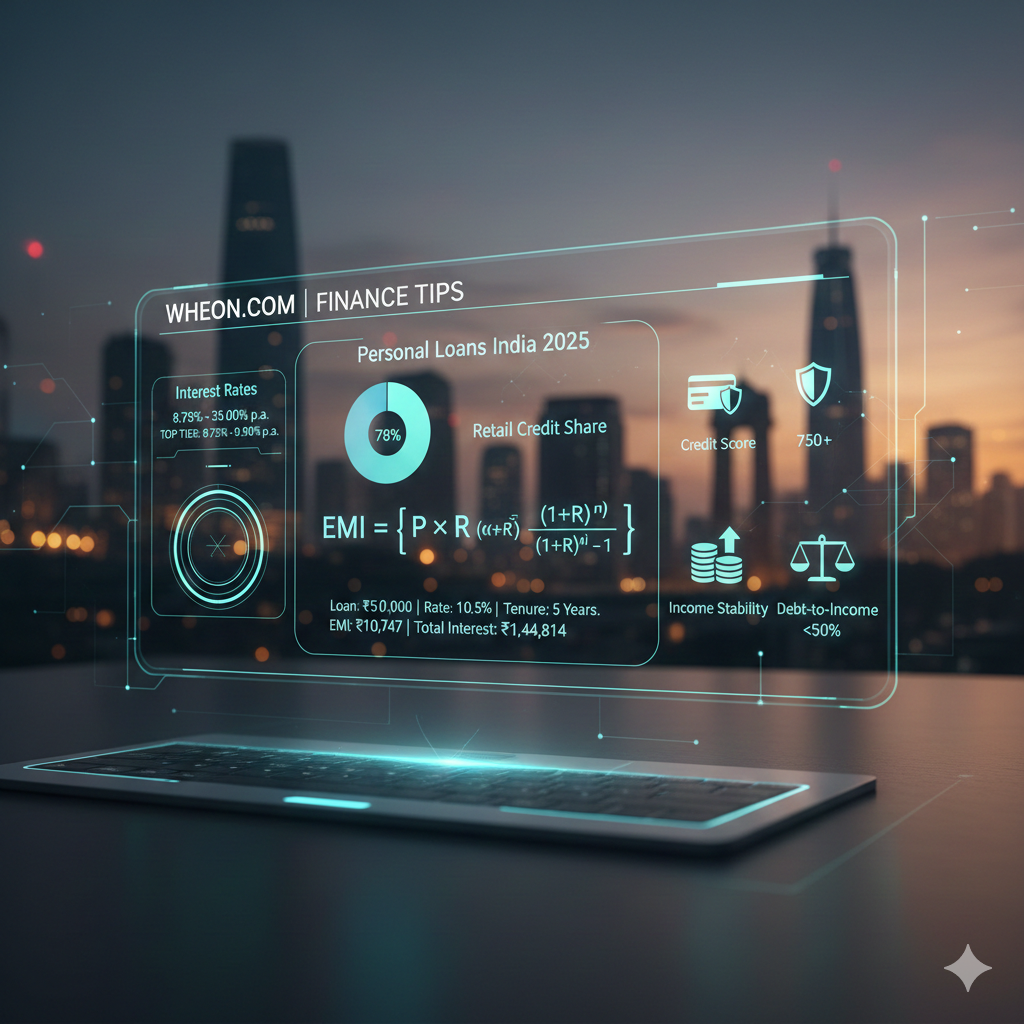
In the rapidly evolving financial landscape of 2025, personal loans have emerged as the most popular credit instrument in India, accounting for over 78% of all retail credit. Whether you are looking to consolidate high-interest debt, fund a dream wedding, or manage a medical emergency, the interest rate you secure is the single most important factor determining the cost of your loan.
As of December 2025, the personal loan market is highly competitive, with interest rates starting as low as 8.75% to 9.90% p.a. for top-tier borrowers. However, the range is vast, with some lenders charging up to 35% p.a. for higher-risk profiles. Understanding how these rates work is crucial, and for those looking for more expert advice, checking wheon com finance tips can provide deeper insights into managing your personal wealth effectively.
1. Top Bank & NBFC Interest Rates (December 2025)
The Indian market is divided between Public Sector Banks (PSBs), Private Banks, and Non-Banking Financial Companies (NBFCs). Each offers distinct advantages depending on your profile.
Leading Banks and Their Current Rates:
-
Bank of Maharashtra: 8.75% – 13.55% (Currently among the lowest in the market).
-
HDFC Bank: 9.99% – 24.00% (Instant 10-second disbursal for pre-approved users).
-
State Bank of India (SBI): 10.05% – 15.05% (No processing fees for applications through January 2026).
-
Kotak Mahindra Bank: 9.98% – 17.20% (Competitive rates for salaried professionals).
-
Axis Bank: 9.99% – 22.00% (Flexible tenure up to 6 years).
-
IDFC FIRST Bank: 9.99% onwards (100% digital process with zero foreclosure charges).
-
Bajaj Finserv: 11.00% – 31.00% (High loan amounts with minimal documentation).
2. Factors Influencing Your Personal Loan Interest Rate
Lenders in 2025 use Risk-Based Pricing. This means the rate you see in advertisements is the “best-case scenario,” while your actual rate depends on your individual risk profile.
-
Credit Score (CIBIL): This remains the “gold standard.” A score of 750+ typically unlocks rates below 10.50%. If your score is below 650, you may be pushed toward NBFCs with rates exceeding 18%.
-
Income Stability: Lenders prefer salaried individuals working in Fortune 500 companies, PSUs, or Government sectors. These individuals are seen as “low-risk,” often receiving a 0.25% to 0.75% discount on standard rates.
-
Debt-to-Income (DTI) Ratio: Most banks want your total monthly EMIs to be less than 40-50% of your net monthly income. A lower DTI indicates higher repayment capacity and can help negotiate a lower rate.
-
Existing Relationship: Your “Home Bank” (where you hold a salary account or FD) is likely to offer you pre-approved loans with lower processing fees and faster disbursal.
3. How Interest is Calculated: The Reducing Balance Method
Most Indian lenders use the Monthly Reducing Balance Method. Unlike flat rates, where interest is charged on the original principal for the entire tenure, this method calculates interest on the remaining principal each month.
The standard formula for calculating your Equated Monthly Installment (EMI) is:
Where:
-
P = Principal loan amount
-
R = Monthly interest rate (Annual rate / 12 / 100)
-
n = Loan tenure in months
Example: If you borrow ₹5,00,000 at 10.5% for 5 years (60 months), your monthly EMI would be approximately ₹10,747, and the total interest payable over the tenure would be ₹1,44,814.
4. The Hidden Costs: Processing Fees & Prepayment
A low interest rate isn’t the only metric of a “cheap” loan. You must look at the Annual Percentage Rate (APR), which includes all costs.
-
Processing Fees: Usually 0.5% to 2.5% of the loan amount. Some banks like SBI or ICICI often waive this during festive seasons.
-
Prepayment/Foreclosure Charges: If you want to close your loan early, banks may charge 2% to 5% of the outstanding principal. Digital lenders like IDFC FIRST often offer Zero Foreclosure after 6-12 months.
-
Insurance: Lenders may “bundle” credit insurance. While optional, it protects your family from the debt, but it adds to the upfront cost.
5. Strategies to Get the Lowest Interest Rate in 2025
-
Shop Around: Use financial marketplaces to compare at least 3-4 lenders before applying.
-
Timing Matters: Apply during festive months (Oct–Jan) when most banks offer “Zero Processing Fee” campaigns.
-
Consolidate Debt: If you have multiple credit card debts, taking one personal loan at 11% to pay off cards at 40% can save you thousands.
-
Shorten the Tenure: While a 5-year tenure has lower EMIs, a 2-year tenure will drastically reduce your total interest outgo.
-
Check for Balance Transfer: If you already have a loan at a high rate, look for Personal Loan Balance Transfer offers. Lenders often offer a 0.50% lower rate to poach customers from other banks.
Conclusion
Securing a personal loan in India today is easier than ever due to digital-first processing. However, the “cheapest” loan is a combination of a low interest rate, minimal fees, and the flexibility to prepay. Always calculate your EMI beforehand and ensure your total debt repayments don’t stifle your monthly savings. For more detailed guides, always stay updated with wheon com finance tips to make informed financial decisions.
